This case study highlights how Becker helped a Cincinnati-area hospital swap out their old, faulty vacuum pumps for a new, reliable system in less than an hour.
A hospital’s medical vacuum system is critical; any failure of this life-sustaining equipment could be disastrous. The Facilities Manager at one Cincinnati-area hospital knew that his vacuum system was aging and in need of repair.
The manager looked to the experts at Becker Pumps for support. Let’s explore this situation in detail—and then see how it was successfully resolved.
A MEDICAL VACUUM SYSTEM PRIMED FOR FAILURE
The 400-bed hospital’s antiquated medical vacuum system had undergone multiple repairs. One of the four 10-HP oil-lubricated pumps had already had a motor burnout. The undersized system was running hard, and it barely met the standards set out in NFPA 99. And, to make matters worse, the control panel technology was frustratingly out of date.
It was clear the system was headed for failure, and soon. How did Becker handle this?
BECKER SWAPS OUT THE PUMPS IN LESS THAN AN HOUR
For more than three decades, Becker Pumps has supported the healthcare industry with medical, surgical, and laboratory vacuum systems. They responded to the facilities manager by creating a thorough quote and walking him through it. Becker had all the essential information and addressed the manager’s questions immediately.
In short, Becker knew what they were doing.
Before the installation, a Becker specialist visited the hospital to assess the building. The value of this on-site exploration was irreplaceable, as they discovered the hospital had an uncommon difficulty—the pump room wasn’t in the basement. It was on an upper level amid several offices, which meant controlling noise levels was particularly important.

After the assessment, Becker recommended their oil-lubricated rotary vane vacuum technology. They chose this type of pump for the hospital’s medical vacuum system for several reasons:
- Vacuum capability – the oil-lubricated rotary vane is an excellent choice for applications that require a high vacuum.
- Robust design – the single shaft direct drive offers a long life with low operation and maintenance costs.
- Lower noise levels – a relatively quiet pump, the decibel levels of an oil-lubricated pump are lower than oil-less technology.
Becker’s in-person visit allowed them to proactively identify—and solve—potential installation concerns. While at the hospital, the Becker specialist checked a few things. 1) that the new pumps would fit into the service elevator, 2) that the system would fit the limited space in the facility’s sound-dampened pump room, and 3) that the new system could snug in next to the old one, so the hospital could avoid removing their outdated pumps.
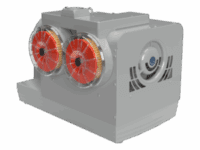
Becker replaced the hospital’s older pumps with an expandable oil-lubricated rotary vane medical vacuum system.
Their Advantage-L and Advantage-P systems are modular and easily expand to include up to six pumps. The option for expansion was ideal for the hospital, as it could accommodate future growth. Because of its well-thought-out design, Becker’s system can be expanded to include additional pumps—without shutting down the vacuum system or discarding any existing parts.
The installation of this expandable system was scheduled for 4 a.m. when the hospital was least busy. After the job was complete, Becker did a full start-up of the system.
Becker’s run-through included:
- Checking each pump for proper operation and good connections.
- Electrical testing—turning the system on and off quickly, ensuring the pumps alternate correctly, and that the valves are isolated.
- Opening the pumps up to the receiver then pulling the receiver down.
- Ensuring the system to the hospital was leak-free.
- Testing the control panel to verify that the electronics handle the pump’s lead/lag sequencing automatically.
Swapping the old system to the new expandable system took just one hour!
Becker’s support extended beyond installing the medical vacuum pumps to include in-person training for hospital staff on how to use the control panel and maintain the pumps.
A SATISFIED CUSTOMER, SO HAPPY THEY ORDERED MORE
Becker Pumps not only completed the hospital pump project on time and on budget, but their system also hit the hospital’s three biggest priorities: pump reliability, affordability, and ease of maintenance.
The Facilities Manager appreciated how Becker took the time to understand their system and develop an effective solution. Based on the hospital’s positive experience at their Cincinnati location, the Ohio-based hospital ordered 12 more Becker systems to support their other facilities.
Becker is ready to help you with the selection, support, and service of your medical vacuum system.