
Vacuum pumps are essential components in countless industrial, medical, and laboratory systems, responsible for removing gas molecules from a sealed volume to create a vacuum. By generating negative pressure, vacuum pumps enable a wide variety of processes, from material handling and packaging to degassing and pneumatic conveying.
Although all vacuum pumps serve the same fundamental purpose—removing air or gas to create suction—their internal mechanisms and ideal applications vary significantly depending on the type of pump.

How Vacuum Pumps Work
At their core, vacuum pumps create suction by reducing pressure, but not all pumps do this in the same way. Most vacuum technologies fall into one of two categories: positive displacement or centrifugal. Positive displacement pumps create a vacuum by trapping and compressing air, while centrifugal pumps rely on rotational speed to move air and generate suction. The continuous suction maintains the desired vacuum level for the system’s application.
The specific way this process occurs depends on the pump’s mechanical design and whether it uses lubrication, contactless operation, or other means of gas displacement.
Below is a closer look at the main vacuum pump technologies Becker offers, along with how each functions.
Oil-Free Rotary Vane Vacuum Pumps
Oil-free rotary vane vacuum pumps use a rotor with sliding vanes housed eccentrically within a cylindrical chamber. As the rotor turns, the vanes slide outward, trapping and compressing air before exhausting it.
Because no oil is used for sealing or lubrication, these pumps are known for their robustness, reliability, and ease of maintenance. They are commonly used for applications such as vacuum hold-down, pick-and-place systems, vacuum lifting, and evacuation, and are widely used in CNC routing, printing, secondary packaging, robotics, and select medical applications.
Oil-Lubricated Rotary Vane Vacuum Pumps
Oil-lubricated rotary vane pumps operate on the same basic principle, but they use oil to seal internal clearances, lubricate the vanes, and dissipate heat. The result is higher achievable vacuum levels and smoother, quieter operation. These pumps are often used in applications that require a deeper vacuum and consistent long-term performance, such as evacuation and degassing, making them a good choice for laboratory systems, plastics, RTM, and primary and food packaging.
Claw Vacuum Pumps
Claw vacuum pumps feature two claw-shaped rotors that rotate in opposite directions without contact. Their synchronized motion traps and compresses air, discharging it at the outlet.
This dry, contactless design ensures high efficiency, low maintenance, and no contamination from lubricants, making them ideal for applications like pneumatic conveying, extracting, and medical vacuum systems.
Dry Screw Vacuum Pumps
In a dry screw vacuum pump, two screw-shaped rotors rotate in opposite directions, trapping gas and compressing it toward the exhaust. These pumps handle larger gas volumes efficiently, even under harsh conditions.
They are well-suited for chemical processing, drying, and solvent recovery systems where vapor handling and contamination control are critical.
Roots Booster Vacuum Pumps
Roots booster pumps, also known as a type of root blower, use two counter-rotating lobed rotors to move large volumes of gas at low pressure differentials, but they do not operate on their own.
Unlike true roots blowers, roots booster pumps must be paired with a backing pump and operate under deeper vacuum conditions. When used in this configuration, they significantly increase pumping speed and system performance at lower pressure levels. They are frequently used in industrial processes that require rapid evacuation like primary packaging.
Radial Vacuum Pumps
Radial vacuum pumps use impellers that accelerate air outward into a radial channel, where it is compressed before discharge.
This design provides smooth, pulsation-free airflow at low vacuum levels, making radial pumps ideal for air-handling or conveying.
Regenerative Blowers
Regenerative blowers, or side-channel blowers, use an impeller with fins or blades to draw in air and accelerate it along the housing. As the air moves through the blower, it is repeatedly cycled over the impeller blades, gradually building pressure before being discharged.
Regenerative blowers are available in both single-stage and double-stage configurations. Single-stage models pass air through the blower once, using both sides of the impeller, which results in higher airflow but lower achievable vacuum. Double-stage blowers route the air around the impeller twice, increasing vacuum capability while reducing overall flow.

Both single- and double-stage models are well-suited for applications such as pneumatic conveying, gas recirculation, and pick-and-place operations. They are also commonly used for vacuum fixing in high-flow applications and select secondary packaging processes, with pressure-based versions often serving environmental applications.
Common Applications of Vacuum Pumps
Because they can generate controlled suction or airflow, vacuum pumps are integral to numerous industrial and medical applications:
- Degassing: Removing air or gas bubbles from liquids, coatings, or resins to improve material consistency and product quality.
- Extracting: Drawing air or vapors from sealed containers or systems, commonly used in laboratory and chemical processes.
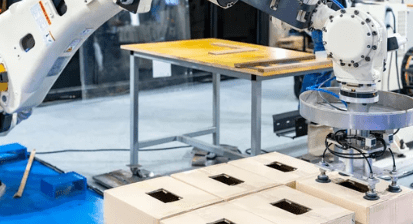
- Pick and Place: Creating suction to lift and move parts, packaging, or products in automation and robotics.
- Vacuum Fixing: Holding materials firmly in place during machining, woodworking, or printing.
- Gas Recirculation: Maintaining continuous flow and pressure control in systems where gases must be reused or purified.
- Pneumatic Conveying: Transporting powders, granules, or small components through pipelines using air movement.
Across industries—from food processing to plastics, electronics to woodworking, and more—vacuum pumps enable greater efficiency, precision, and reliability.
Becker: Your Vacuum Pump Experts
At Becker Pumps, we’ve spent decades advancing vacuum technology to meet the demands of modern industry. Our full line of vacuum pumps covers every performance requirement, from oil-free, contamination-free operation to high-efficiency deep vacuum systems.Whether you need a reliable pump for a single machine or a complete centralized vacuum system, Becker’s engineers are ready to help you find the perfect system for your application.


