Facilities managers in charge of a hospital’s vacuum system rely on the central medical vacuum control panel as part of their job. The panel represents the “brains” of the vacuum system, and staff use it to monitor, manage, and maintain vacuum pressure when and where it’s needed throughout a facility.
Understanding the central medical vacuum control panel, how it works, and why you need one will help highlight the equipment’s critical role within the healthcare industry.
Let’s explore some of the life-sustaining features you’ll find built into a Becker control panel.
THE BECKER SERIES 5 CENTRAL MEDICAL VACUUM CONTROL PANEL
At Becker Pumps, we’ve manufactured medical vacuum systems for decades. Our Series 5 panel meets all NFPA 99 (National Fire Protection Agency’s healthcare facilities code) and NEMA (National Electrical Manufacturers Association) requirements. These panels include essential features and modern capabilities that make vacuum management easier.
AN EXPANDABLE CAPACITY FOR MORE PUMPS
Series 5 control panels are expandable, allowing up to six vacuum pumps to be added with minimal disruption. The scalable control panel extends the usefulness of your current central medical vacuum system, setting it up to meet your facility’s future needs.
AUTOMATED LEAD/LAG PUMP SEQUENCING
Alternating the multiple pumps of a medical vacuum system ensures an equal run time on each unit. This alternation promotes pump longevity and strengthens the reliability of the entire system.
Operating pumps using a “first-on, first-off” programming strategy is called lead/lag sequencing or “cascading” controls. The Series 5 control panel enables lead/lag sequencing for all pumps, including the reserve pump (to prevent deterioration due to lack of use). Control panel features also include adjustable min/max run timers for optimal pump functionality.
INTUITIVE ALARM SYSTEMS
The ability to alert operators to potential problems is one of the most valuable functions of a central medical vacuum control panel. Staff needs to be able to diagnose and fix problems quickly to avoid a potentially devastating system failure.
Series 5 control panels feature alarm lamps to draw visual attention in a noisy environment. Steady or flashing lights indicate different alarm situations at a glance.
A sound horn, such as a 95 dB tone, also signals an alarm condition. A push-to-silence button allows a worker to acknowledge the alarm and mute the buzzer once they’ve responded.
Situations that could set off an alarm include:
- Reserve pump in-use
- Low voltage
- Low vacuum
- Low oil
- High exhaust filter pressure
- High discharge temperature
- CVT failure
ADVANCED OPERATOR INTERFACE
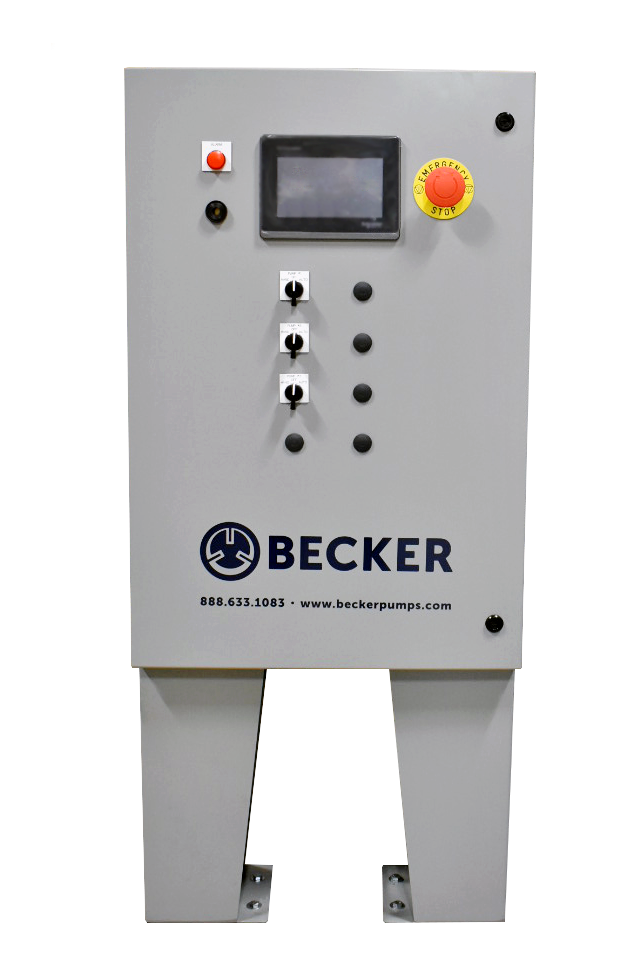
A well-designed central medical vacuum control panel should make monitoring and operation intuitive. The advanced features of Becker’s Series 5 panels do just that.
A physical HOA (hand-off-auto) switch for each vacuum pump supports individual control of each unit, while a 7” touchscreen LCD provides access to the system management options.
Using the LCD screen, staff can view system status and fine-tune settings, such as high/low setpoints and min/max run time. The LCD can also be used to monitor individual pump units, including their average amperage and amperage per phase.
FLEXIBLE COMMUNICATION OPTIONS
Within the control panel, an industrial computer called the programmable logic controller, or PLC, receives signals from the pressure transducer and selector switches. The PLC sends signals to the pump motor starters and essentially tells the system how to operate.
A PLC also permits the communication of system operation data via several methods, including
- Ethernet/IP slave device
- Modbus TCP
- SMS/email notifications
- Web server (WAGU WebVisu)
These capabilities let operations staff receive alarm notifications on devices, such as cell phones, and also grant access to the central medical vacuum control panel remotely via the internet.
Becker’s Series 5 control panel can be integrated with a facility’s building management system (BMS). Using industry-standard protocols, including Modbus and BACnet, operations personnel can conveniently manage a medical vacuum system through an existing BMS interface.
NFPA 99 COMPLIANCE
In the United States, NFPA 99: Health Care Facility Code sets out requirements for medical vacuum systems to ensure they’re safe to use and minimize risk to staff, patients, and visitors. As part of a medical vacuum system, the control panel must meet NFPA 99 requirements, including redundant transformers, to ensure system uptime.
NEMA-RATED
The National Electrical Manufacturers Association (NEMA) standards for medical systems require a control panel to have an enclosure appropriate to the setting. Our panels can meet ratings for Type 3R, 4, and 12, which account for different environments such as blowing water, dirt, ice formation, and condensation.
THE CONTROL PANEL IS A VITAL PART OF A CENTRAL MEDICAL VACUUM SYSTEM
Medical vacuum systems deliver life-sustaining suction for healthcare facilities. The features you need for a superior central medical vacuum system control panel are in Becker’s Series 5—an advanced interface, including system expandability and comprehensive alarm functionality.
Contact Becker Pumps to find out how to put the latest control panel technology to work at your facility.