When selecting the best vacuum pump for your application, understanding the differences between technologies is critical to achieving long-term performance and value. Two of the most common vacuum pump types in industrial and manufacturing applications are claw and rotary vane vacuum pumps. Each comes with its own set of strengths and trade-offs. At Becker Pumps, we offer both technologies and aim to help you choose the best pump for your application by breaking down their performance, maintenance requirements, and overall cost.
In this article, we’ll explore the pros and cons of claw and rotary vane vacuum pumps, outline key applications for each pump, and explain why understanding the total cost of ownership is just as important as evaluating the initial investment.
UNDERSTANDING CLAW VACUUM PUMPS
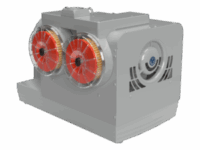
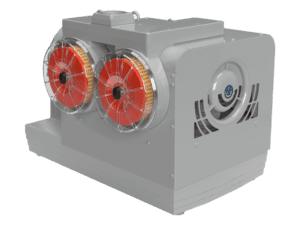
Claw vacuum pumps, also known as hook and claw pumps, operate using two dry-running claw-shaped rotors that move in opposite directions without touching each other or the pump housing. The claw design compresses air and discharges it through an exhaust port, producing a consistent, oil-free vacuum.
PROS OF CLAW VACUUM PUMPS:
- Low Maintenance: Claw pumps have no vanes to replace and require less frequent service than vane pumps.
- Dry Running: No oil or lubricant is needed in the compression chamber, reducing contamination risks and simplifying upkeep.
- Energy Efficiency: Modern claw pumps are often more energy-efficient under steady-state operation due to optimized internal compression.
- Longer Service Life: The lack of internal contact means less wear and longer intervals between overhauls.
CONS OF CLAW VACUUM PUMPS:
- Higher Initial Cost: Claw pumps typically come with a higher up-front investment compared to rotary vane pumps due to their more intricate design.
- More Complex Repairs: Claw pumps often require trained technicians for repairs due to their more intricate design.
Noise: Claw pumps can sometimes operate at a higher noise level than rotary vane alternatives, depending on design and application.
UNDERSTANDING ROTARY VANE VACUUM PUMPS
Rotary vane vacuum pumps, available in both oil-lubricated and oil-less models, use a rotor with vanes that slide in and out to compress air as the rotor spins. Air is chambered, compressed, and then the hot air is ejected. The sliding vanes are in constant contact with the pump chamber, which enables effective vacuum generation.

PROS OF ROTARY VANE VACUUM PUMPS:
- Lower Initial Investment: Rotary vane pumps are typically more affordable upfront, making them appealing for operations with tight budgets.
- Reliable Performance: Proven technology that delivers consistent vacuum across a wide range of applications.
- Compact and Quiet: Many rotary vane models are compact, easy to install, and operate with less noise than a claw pump.
- Simple Maintenance & Repairs: Routine repairs—like vane or oil replacement—can often be performed in-house without a specialist.
- Deeper Vacuum Capability: Oil-flooded pumps can achieve lower ultimate vacuum levels for demanding applications.
- Contaminant Resistance: Oil-lubricated pumps offer greater protection and durability when exposed to particulates or vapors.
- Adjustable Operating Pressure: Relief valves on dry rotary vane pumps allow easy fine-tuning of pressure levels.
- Faster Recovery After Failure: Rotary vane pumps can often be returned to operation more quickly due to easier repairs.
CONS OF ROTARY VANE VACUUM PUMPS:
- Higher Maintenance Needs: Rotary vane pumps require regular vane replacement and oil changes, which add to ongoing maintenance costs.
- Oil Contamination Risk: In oil-lubricated models, there’s always a risk of oil carryover, especially in sensitive applications.
- Shorter Service Intervals: Due to the constant friction of moving vanes, these pumps often need more frequent service.
COMMON APPLICATIONS & INDUSTRIES
Claw and rotary vane vacuum pumps are both versatile and serve many overlapping applications. Both pump types are commonly used for pneumatic conveying, extraction, and pick-and-place systems, especially in automated manufacturing environments where reliability and precision are key.
CLAW VACUUM PUMP APPLICATIONS
Claw vacuum pumps are especially well-suited for clean, continuous-duty, and oil-free operations.
Common Industries & Uses:
- Medical & Healthcare: Ideal for medical vacuum systems and dental applications, where low maintenance is a priority.
- Electronics Manufacturing: Used in component handling and vacuum processes that require oil-free operation and consistent performance.
- Composite Manufacturing: Effective in resin infusion, vacuum bagging, and other composite production techniques where clean, dry vacuum is required.
- Plastics Manufacturing: Pneumatic conveying of pellets for extrusion machines, thermoforming, pick and placement of parts, and holding for parts trimming.
ROTARY VANE VACUUM PUMP APPLICATIONS
Rotary vane pumps remain a reliable, cost-effective choice for a wide variety of general-duty applications.
Common Industries & Uses:
- Woodworking: Trusted for vacuum hold-down in CNC routing and cutting systems.
- General Mechanical: Used in many mechanical processes such as conveying, transporting, fixing, lifting, drying, handling, cooling, and more.
- Primary Packaging & Food Processing: Help keep inline tray sealers, chamber machines, rotary chamber machines, tumblers, and massagers running.
TOTAL COST OF OWNERSHIP: THE HIDDEN FACTOR
While rotary vane vacuum pumps are often less expensive upfront, claw vacuum pumps generally offer a lower total cost of ownership over time. Here’s why:
| Factor | Rotary Vane Pump | Claw Pump |
| Initial Cost | Lower | Higher |
| Maintenance Frequency | Moderate (vane/oil replacement) | Lower (minimal wear components) |
| Operating Costs | Moderate (due to spare parts) | Lower (dry running, energy-efficient) |
| Downtime Risk | Moderate (more service interruptions, but quicker to get up and running) | Lower (longer intervals between services) |
| Repair Complexity | Simple, can often be in-house | Requires expert service |
| Lifespan | Long | Long |
If you value minimal maintenance and long-term reliability, the claw pump offers significant cost advantages. But if your team can handle in-house maintenance, the rotary vane pump is an excellent and economical option.
WE’RE HERE TO HELP YOU CHOOSE THE RIGHT PUMP
At Becker Pumps, we manufacture both claw and rotary vane vacuum pumps, giving our customers access to the best technology for their unique needs. Whether you value the long-term efficiency and low maintenance of a claw pump or need the affordability and compact performance of a rotary vane pump, we’ve got a solution that fits.
Let our team help you determine the right vacuum pump based on your operational goals, industry demands, and budget. Contact Becker Pumps today to speak with a vacuum specialist and explore our full range of vacuum pump options.