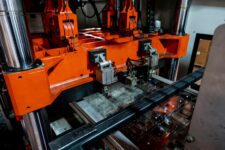
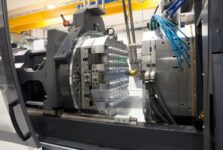
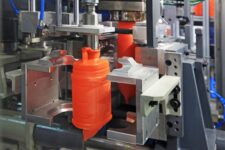
Modern plastics manufacturing is built on speed, precision, and consistency.
Whether producing parts through thermoforming, injection molding, or rubber molding, manufacturers rely on a steady, uninterrupted flow of raw materials to keep production lines running efficiently. In these high-volume environments, even minor disruptions in material delivery can lead to downtime, scrap, and lost revenue.
That’s where pneumatic conveying and the vacuum pumps behind it play a critical role.
WHAT IS PNEUMATIC CONVEYING?
Pneumatic conveying is the process of moving bulk materials—such as plastic pellets, regrind, or powders—through a closed pipeline using airflow. Instead of relying on manual transport or mechanical systems like conveyors or augers, pneumatic systems use air pressure (or vacuum) to move materials from one point to another.
In plastics manufacturing, this typically means transferring resin from storage silos or railcars directly to processing equipment like molding machines or extruders.
Among the different types of pneumatic systems, vacuum conveying is especially common. Rather than pushing material through the line with positive pressure, vacuum systems pull material through the pipeline using negative pressure generated by a vacuum pump.
WHY PLASTICS MANUFACTURERS PREFER VACUUM CONVEYING SYSTEMS
Vacuum-based pneumatic conveying systems have become the preferred choice in plastics processing for several key reasons:
CLEAN, ENCLOSED TRANSFER
Because materials move through sealed pipelines, vacuum conveying minimizes dust, spills, and exposure to contaminants. This is especially important for maintaining product quality and meeting cleanliness standards.
REDUCED MATERIAL CONTAMINATION
Closed-loop conveying protects sensitive materials from environmental factors such as moisture, debris, and cross-contamination between resin types.
CONSISTENT FEED RATES
Vacuum systems provide controlled, repeatable material flow, ensuring that processing equipment receives a steady supply of resin, critical for maintaining part quality and cycle times.
FLEXIBLE SYSTEM DESIGN
Vacuum conveying systems can be easily integrated into complex plant layouts, allowing manufacturers to move materials across long distances or multiple destinations.
IMPROVED AUTOMATION
By eliminating manual handling, vacuum conveying supports fully automated workflows, reducing labor requirements and human error.
THE ROLE OF VACUUM PUMPS IN PNEUMATIC CONVEYING
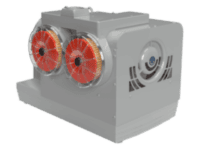
At the center of every vacuum conveying system is the vacuum pump, the component responsible for generating the negative pressure that moves material through the pipeline.
Here’s how it works:
- Vacuum Generation: The vacuum pump removes air from the conveying line, creating a pressure differential between the material source and the destination.
- Material Pickup: This pressure differential draws ambient air and the material within it into the conveying line at the pickup point.
- Material Transport: As air continues to flow toward the vacuum source, it carries pellets, powders, or regrind through the pipeline.
- Separation and Discharge: At the destination, a receiver or separator removes the material from the airstream and deposits it into a hopper, while filtered air continues through the system.
- Continuous Operation: The vacuum pump maintains consistent airflow, ensuring reliable material movement and steady system performance.
Without the vacuum pump, the entire system would cease to function. It is the driving force that enables precise, efficient, and automated material handling.
SUPPORTING EFFICIENCY ACROSS THE PLASTICS WORKFLOW
Vacuum pumps don’t just move material. They help optimize the entire plastics manufacturing process in the following ways.
MINIMIZED DOWNTIME
Reliable vacuum performance ensures that material is always available at the point of use, preventing production interruptions.
IMPROVED PRODUCT QUALITY
Consistent material delivery reduces variability in molding or extrusion processes, leading to higher-quality finished products.
LOWER MAINTENANCE REQUIREMENTS
Compared to mechanical conveying systems, vacuum-based systems typically have fewer moving parts in contact with material, reducing wear and maintenance needs.
ENERGY AND OPERATIONAL EFFICIENCY
Modern vacuum pump technologies are designed for continuous operation with optimized energy consumption, helping manufacturers manage operating costs.
SCALABILITY FOR GROWTH
As production demands increase, vacuum conveying systems can be expanded or modified without major disruptions to existing operations.
WHY VACUUM PUMPS ARE ESSENTIAL, NOT OPTIONAL
In today’s plastics facilities, pneumatic conveying is no longer a convenience; it’s become a necessity. And at the heart of that system, vacuum pumps do far more than support operations in the background.
They enable automation.
They protect material integrity.
They ensure consistent throughput.
In short, they make modern plastics manufacturing possible.
PARTNER WITH BECKER FOR RELIABLE VACUUM PERFORMANCE
At Becker, we understand the critical role vacuum pumps play in pneumatic conveying and plastics manufacturing as a whole. Our vacuum solutions are engineered for reliability, efficiency, and long-term performance, helping you maintain consistent material flow and keep your production lines running at peak efficiency.
Whether you’re designing a new system or optimizing an existing one, our team is here to help you find the right solution for your application.