In high-volume plastics manufacturing, one of the most widely used processes for quickly and consistently producing parts is thermoforming. From medical trays and food packaging to appliance panels and automotive interior components, thermoformed plastics are everywhere, but consistent quality and efficiency rely on more than just molds and machines. The vacuum system plays a central role, shaping, stabilizing, and ensuring precision for every part while keeping production running smoothly.
For manufacturers, the question is whether your vacuum system can keep up with the demands of modern production. An inefficient or poorly matched pump can create inconsistencies in wall thickness, surface defects, and slower cycle times, while also driving up maintenance and energy costs. On the other hand, a properly sized and reliable vacuum pump ensures sharp details, uniform parts, and smooth, uninterrupted operation.
This blog explores why vacuum pumps are essential in thermoforming, how they influence part quality and throughput, and what to consider when choosing the right pump to maximize efficiency and reliability across your production line.
The Critical Role of Vacuum in Thermoforming
Thermoforming may seem straightforward, but achieving consistent, high-quality results requires precise control at every stage.
Heating the Plastic Sheet: The process begins with a flat plastic sheet heated to a pliable state. While vacuum isn’t applied during heating, uniform temperature ensures the material will respond properly in the forming stage.
Forming Over the Mold: Once heated, the sheet is drawn over a mold while the vacuum pump removes air from the cavity. The resulting pressure differential shapes the plastic precisely to the mold’s contours. A properly sized, reliable vacuum pump ensures sharp details, consistent wall thickness, and the elimination of air pockets or defects.
Cooling the Formed Part: Maintaining vacuum during cooling keeps the part stable, preventing warping, shrinkage, or dimensional inconsistencies.
Part Release and Cycle Repeat: Fast, continuous vacuum operation enables smooth part release and repeatable cycles, keeping high-speed production lines running efficiently and minimizing costly downtime.
In thermoforming, vacuum directly impacts:
Part Quality
- Accurate mold replication
- Reduced defects and scrap
- Consistent wall thickness
Throughput
- Faster cycle times
- Reduced rework
- Stable high-speed production
Operational Efficiency
- Lower energy consumption compared to inefficient alternatives
- Reduced maintenance and downtime
- Predictable performance over long production runs
Switching from inefficient vacuum generation methods to a properly matched dedicated vacuum pump can significantly reduce operating costs and maintenance burdens while improving reliability.
Best Vacuum Pumps for Thermoforming
Selecting the best vacuum pump for thermoforming depends on several factors, including the required vacuum level, cycle speed, material type, product complexity, and system design (point-of-use vs. centralized).
Becker offers three distinct vacuum pump technologies for thermoforming—one of the most complete selections in the industry. Here’s how to think about which technology fits your application:
Oil-Free Rotary Vane Vacuum Pumps (VT, KVT, & VTLF Series)
Becker’s oil-less rotary vane pumps are the industry standard for clean, “dry” vacuum. These pumps utilize self-lubricating graphite composite vanes—eliminating oil changes and contamination risks—making them ideal for food, medical, and cleanroom thermoforming.
The Series at a Glance:
- VT Series: Compact and efficient, ideal for smaller equipment like tray formers and blister pack machines. (Up to 28 CFM | 25 in. Hg)
- KVT Series: The “mid-range” workhorse for medium-sized thermoforming applications requiring higher vacuum depth and flow. (Up to 91 CFM | 27 in. Hg)
- VTLF Series: High-capacity pumps designed for large-scale production, heavy-gauge forming, and centralized systems. (Up to 336+ CFM | 27 in. Hg)
Why Thermoformers Choose Them:
- 100% Oil-Free Operation: Eliminates the risk of oil mist or leaks, protecting sensitive food and medical packaging.
- Built-In Protection: KVT and VTLF models come standard with large integral suction filters and clear covers for easy inspection.
- Continuous Duty Rated: Designed for nonstop production environments without the need for water cooling.
- Low Maintenance: Simple construction with a single-shaft direct drive ensures long vane life and fast on-site service.
Oil-Lubricated Rotary Vane Pumps (U Series)
Becker’s U Series pumps use oil to seal the working chambers, allowing them to achieve deeper vacuum levels than dry-running pumps. This makes them well-suited for thermoforming applications that require strong forming force and fine detail reproduction.
Best for: Heavy-gauge thermoforming, deep-draw molds, and applications where deeper vacuum (below 25 in. Hg) is needed for precise detail and complex geometries.
Why thermoformers choose them:
- Capable of achieving fine vacuum levels for demanding forming applications
- Robust, single-shaft direct drive design built for continuous, high-demand operation
- Dual-stage oil separation delivers 99.9%+ oil-free exhaust
- IE3 high-efficiency motors reduce energy costs over the life of the pump
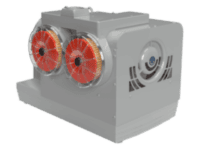
Claw Vacuum Pumps (BCV Series)
Becker’s BCV Series claw pumps are 100% oil-free and contactless during operation. The claw-shaped rotors rotate in opposite directions without touching, making these pumps exceptionally low-maintenance and energy-efficient.
Best for: Tray formers, blister packs, clamshells, and high-throughput thermoforming lines where energy efficiency and minimal maintenance are top priorities.
Why thermoformers choose them:
- Non-contact compression means virtually no internal wear
- Oil-free and air-cooled with minimal maintenance costs
- High efficiency and low energy consumption
- Continuous duty rated with straightforward construction for fast on-site service
A Note on Pump Sizing and System Design
As with any thermoforming application, proper sizing is critical. However, vacuum performance isn’t just about the pump; most efficient systems utilize receiver tanks to act as a vacuum reservoir. This setup allows for rapid air evacuation and significantly reduced cycle times.
When sizing your system, vacuum level and flow rate must align with both the process demands and the tank recovery time. Key factors include:
- Flow Rate (CFM): Ability to evacuate the mold and recover the tank vacuum.
- Target Vacuum Level: The depth of vacuum required for high-definition forming.
- Duty Cycle: Whether the pump runs continuously to maintain the reservoir or intermittently.
- Total System Volume: Including the mold cavity, plumbing, and receiver tank capacity.
Becker’s team can help you calculate the ideal pump-to-tank ratio to optimize performance and energy efficiency for your specific process.
Improve Your Thermoforming Process With The Best Vacuum Pumps
Thermoforming is built on speed, precision, and repeatability. Vacuum is what makes all three possible.
From forming sharp details to maintaining cycle times and ensuring consistent part quality, the role of vacuum pumps in thermoforming cannot be overstated. The right vacuum solution doesn’t just support production, it enhances it.
Whether you’re optimizing an existing process or designing a new system, our team can help you identify the best-fit solution for your operation.
Ready to improve your thermoforming process?